Table of contents
Open Table of contents
Introduction
A quick personal take first, then the practical prep that actually matters.
Disclaimer
This is my subjective take on what the CKA journey should look like. Do not limit yourself to this article. Read other people’s opinions too.
The drama
It was not as easy as I heard from others. Mumshad’s course, the KodeKloud labs, and Killer.sh are great, but not enough, even if you do them several times.
It did not feel like the other certification exams I have passed, CRTO and eCPPTv3.
There is always a thing (or more) that you have never practiced.
Yes. If you have real work practice, you will most likely pass easily.
But if you start fresh and you are not that kind of genius, you should suffer (~enjoy) for a while with much more practice.
The success
In short:
Failed. Thanks for your condolences. Free retake. Passed. Thanks for the congratulations.
How to become certified as a Kubernetes Administrator?
Background
First of all, have some IT background. You should be able to:
- develop apps (no matter how)
- understand networking fundamentals
- work with containerization (Docker/Podman)
- troubleshoot without ChatGPT (must!)
- have stable internet during the exam (do not underestimate this part; otherwise it will cost you around ten minutes of panic during the exam).
Foreground
You probably know most of this already. Anyways.
- Mumshad’s course and lab in KodeKloud.
- Killercoda: everything CKA-related is a must-do. You can try CKAD-related labs too.
- Killer.sh: CKA A and B labs. Their difficulty is comparable to the real exam.
- Some other scenarios from the community. You can find them on Reddit, GitHub, and other social media. Try to work on those too. Do the most starred ones; they are usually better. I will include some resources in the Appendix below.
- Documentation and a lab environment built by yourself.
Documentation and a Lab
Try to build a lab environment from scratch based on the documentation. Then start implementing everything the documentation describes. In parallel you will gain practical experience and learn what information is in the docs.
Try to set up several different labs with different storage, CNI, and topology: a single-control-plane cluster, one control plane with one or more workers, then highly available (HA) with three control planes and one or more workers.
Try to experiment. Do crazy stuff. Break it. Revive it. Pervert the cluster to the max.
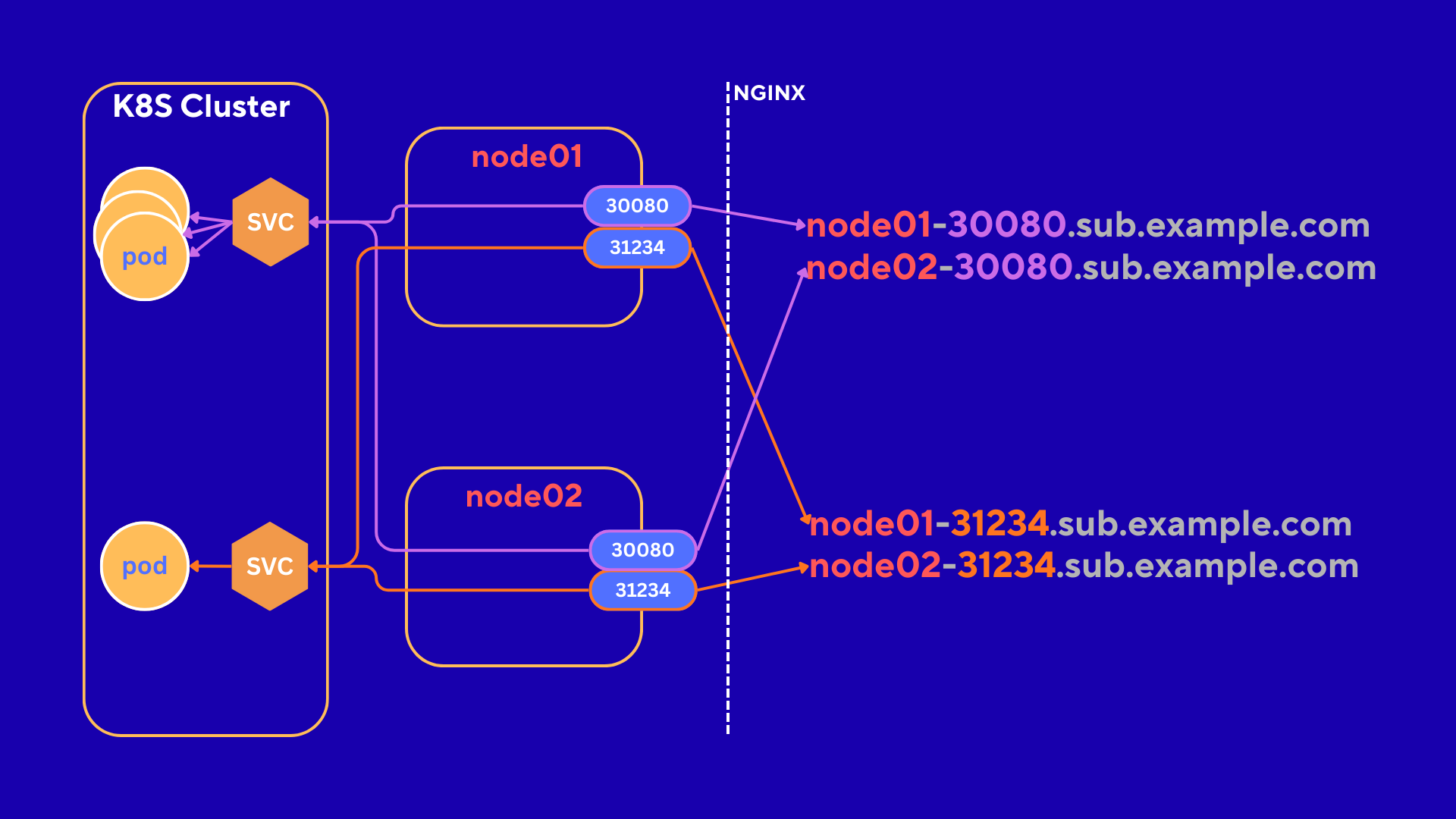
One thing I picked up while tinkering was how to put NodePort services behind friendly subdomains with a reverse proxy and wildcard DNS; I spell out the steps in Access Kubernetes NodePort Services with Subdomains.
Ok. But where can you perform those crimes? Your PC can be enough. But it would be better if you can do it in the cloud. And you can do it for free! Major cloud providers offer trial subscriptions. Deploy VMs there and play around.
Of course, there is no need to read documentation that is unrelated to the CKA. For everything that is related: read it carefully!
Even though I did not do this myself, I recommend reading the documentation for Helm, Kustomize, and the Gateway API too.
Yes, it may seem overkill, but it will make you feel much more comfortable.
But why?
I believe it is worth preparing for the CKA, regardless of who you become in IT. It will make you more suitable for almost any IT role. Knowing how Kubernetes works and how it is maintained matters for DevOps engineers, developers, cybersecurity engineers, and even penetration testers.
It is not only about knowledge but also about persistence and the ability to work through difficulty.
Appendix
- Get a discount:
- Practice:
- theplatformlab / CKA-Certified-Kubernetes-Administrator
- CameronMetcalfe22 / CKA-PREP
- killer.sh (the Linux Foundation gives access to two scenarios after exam purchase)
- Killercoda (free)
- My Badge:
- Recommended Course:
- KodeKloud: Certified Kubernetes Administrator with practice tests (Mumshad Mannambeth)
- Get more information:
- CNCF curriculum
- Linux Foundation: CKA and CKAD tips
- yusif-v / CKA (my friend’s notes are good, check it out!
:))