Table of contents
Open Table of contents
Introduction
For me, late 2022 is the dividing line between the pre-AI and post-AI eras. I mean The True AI Era. I want to express my ideas about how it affects our lives and speculate about what will happen tomorrow.
Chronological Replacement
How did it start? How did I use it? In the beginning, it was just a chat with an intelligence. Today, however, it is a completely different thing.
- I used it to write texts/essays to fill my university reports/presentations.
- I used it to generate ideas for those reports/presentations.
- I used it to generate code snippets to include in my codebase. Still, Copilot in the editor was a thing. It was the main way I developed.
- I used it to create more complex scripts. It was giving me whole files of code.
- I used it to get CLI commands to configure hosts and to troubleshoot things. Around this point, I think I used Stack Overflow for the last time.
- I put it into my code editor, so it guided me and touched some files. Yet, I was still the one setting the general pattern of development. I just used it to fill in the repetitive parts, like generating interfaces or CRUD skeletons with no functionality, and then to help me implement those methods.
- I started to offload more and more coding tasks to it. Eventually, I started using coding agents in my editor. I gave it tasks, it wrote the code, I reviewed it. I tested it myself.
- I began to trust it more and more. It started to plan, instead of me prompting the tasks one by one. My former tasks became its subtasks, and then sub-subtasks. In one go, it could implement an entire component of the app, of the project. It made mistakes often back then, but regardless, it made fewer mistakes than I did.
- I began to allow it to review, to test, to create an entire app (a simple app).
- I started trusting it to deploy, to wire components together, to create an entire project from a single prompt, to run security tests, to fix vulnerabilities.
- Now I use it to create infrastructure, to create clusters, to handle the full development lifecycle.
The Pattern
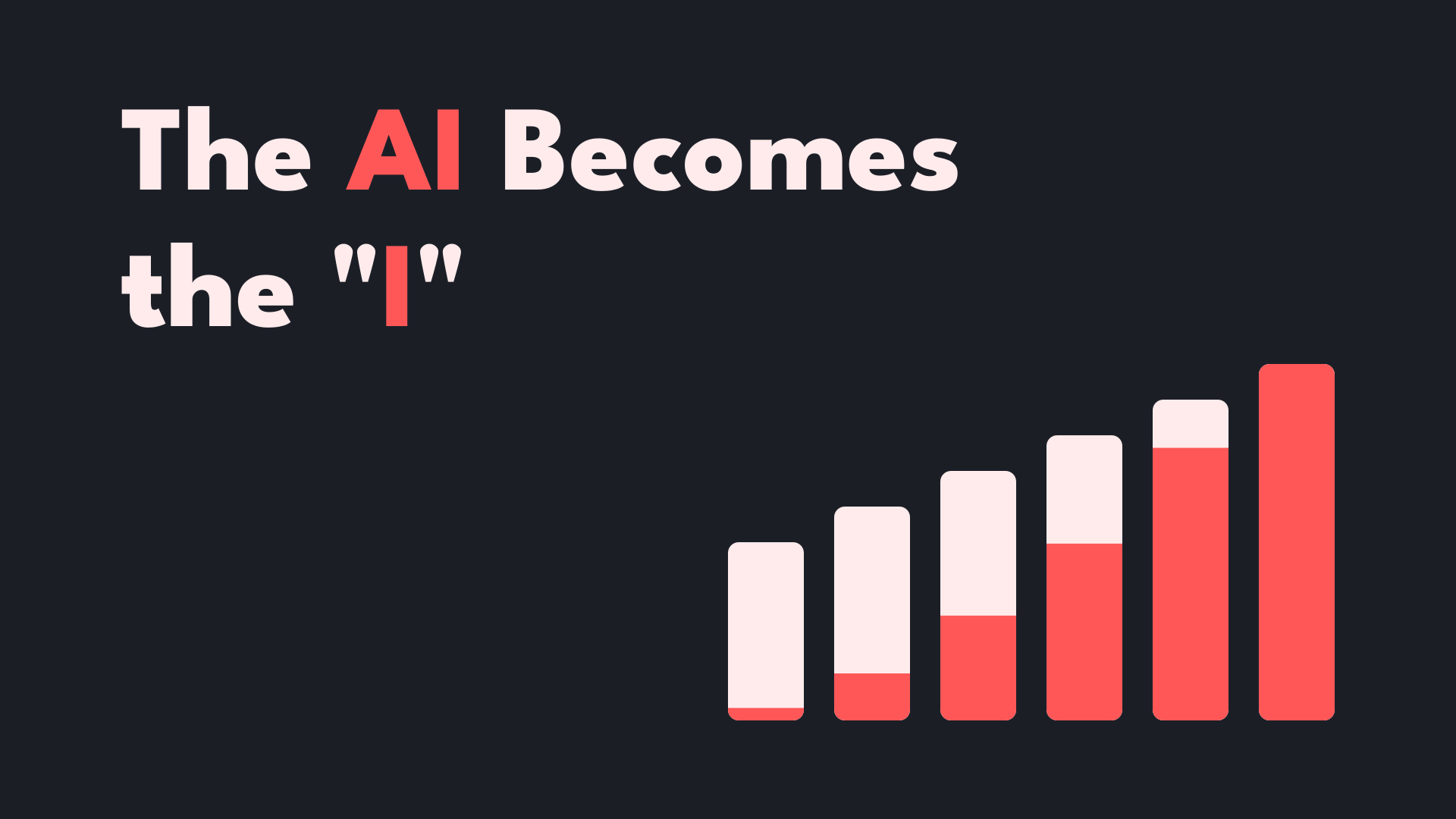
Do you see the pattern in this order? The “I” is shifting further and further left. The AI becomes the “I”. What will happen next? I believe there are smarter people who have made their jobs more autonomous and agentic: make it call people, make it pitch to people, make it produce videos, make it operate robotics, make it create an agentic system that orchestrates everything mentioned here in one go.
If I tried hard, I could deliver a complete project (frontend + backend + DB, with some bugs) in a month. Today, with some hard prompting, I can produce the same project in one chat interface in under 4 hours, with almost no bugs, plus bonuses like observability, security, a Docker/Kubernetes setup, and other bright things.
For credibility, I recommend checking my GitHub. I really do have some projects that I created before the AI boom.
Two-Sided Effect on an IT Individual
The Bright Side
How does it affect us? Differently. Now I have more time for myself: I read more, I cook sometimes, I play games. And at the same time, I am at least 10x as productive as I was 3 years ago.
To be fair, expectations rose too. Jobs today expect us to use AI to get the job done. The workload grew, but completing it became much, much easier.
The Dark Side
Thankfully, I got a job before the AI boom, so I am still surfing the wave of IT job requirements. As expectations rise, I learn more too. I do not stagnate. If I stagnate, I become a replaceable unit. No, this race is not a problem. And it is not difficult either. Following trends and learning more complex tech is not that hard.
But for others, this crazy wave has almost killed junior IT positions. Today, AI agents are our juniors. They make fewer mistakes, they cost less, and they are better than humans in almost every parameter.
Nowadays, it is much harder to get started, to find a first IT job. Most companies hire mid/senior specialists who can operate the agents. So, in retrospect, it is like hiring a team of specialists but paying only the team lead.
You are lucky if you have a job today; you managed to jump onto a train that had almost left the station.
I am not sure how badly (or well) it has affected other industries, but I think the general effect is the same.
The Effect on Society
I had a conversation with my friend about how AI affects humankind as a whole. We started with a small example: consulting. Consultants already use AI, and their clients know it. So the obvious question follows: if your work became cheaper, why didn’t your price? Big firms can ignore it for a while, but once small companies undercut them with the same tools, everyone will have to follow. The same logic applies to almost every industry, and it leads to the real question: what happens to people?
Two Views
My friend’s view was pessimistic. AI lowers the cost of work, so companies lay off more people. A product owner who managed 15 developers now needs one person who understands everything and vibe-codes the rest. And we should plan for how advanced AI will be in 5-10 years, not how advanced it is today. When I said people will still be needed to operate the AI, he answered: sure, one operator per 100,000 people. In his view, human labor keeps losing its value, and the jobs left will be the ones machines are still bad at, like mining and cleaning.
I agree that AI replaces whole teams. I see it at work: our productivity rose roughly 10x, we hired only one or two juniors in the last couple of years, and I alone cover the work of a whole DevSecOps team. But I see the bigger picture differently. If every person becomes 10x more productive, the economy grows. A company that served 10 customers can now serve 100. Its revenue will not grow 10x, because prices drop, but they will not drop one to one either. And where there was one company with a thousand employees, there may now be many small companies with a few people and a lot of agents each. More sellers, more buyers, maybe a boom for the next decades, and then something close to cyberpunk.
Where We Agreed
In the end, we agreed on more than we disagreed. Unemployment will come. Most work that can be automated will be, and what remains are the operators of this automation and jobs built on human-to-human interaction. It will also not happen everywhere at once: developed countries in about 10 years, developing ones in 20-30, the rest maybe in 50. And history already showed us this story during the industrial revolutions. Those who did not adapt were replaced. Those who accepted the new reality found work suited to the new time.
So, the answer is simple: adapt and go with the flow. Those who started before the AI era and grew with it will be fine. Those who stay still will be left behind. As for money, we bet on what AI itself depends on: energy and hardware, like chips and quantum computing. Whatever happens with AI, it will need both.
Science Fiction
I am a big fan of Isaac Asimov. I have read all the main books of the Robot, Galactic Empire, and Foundation series. He was a hard science fiction writer: he connected his ideas logically to our reality. Asimov’s entire universe is a very good thought experiment on how society would realistically develop.
But his science fiction is becoming reality.
I want to briefly summarize the Robot series to show what he predicted back in the 1940s and 50s.
The Robot Series in Brief
At first, robots are just tools, and people fear them. So their creators build safety rules into their core, the Positronic Brain: never harm a human, obey humans, protect yourself. Still, robots keep surprising their engineers with strange behavior that turns out to be a perfectly logical result of those rules. Today we call it AI alignment, guardrails, and debugging a model that follows instructions a bit too literally.
Then robots enter the economy. They do the work better and cheaper, and people start hating them for taking their jobs. Eventually, giant thinking Machines quietly run the whole economy, and humans no longer fully understand their decisions. Sounds familiar? It is the job anxiety we have today, plus algorithms that already decide what we see, buy, and believe.
Then society splits in two. A small group of people leaves Earth and colonizes about fifty worlds with the help of robots. They live for centuries in comfort, with dozens or even thousands of robots per person. Meanwhile, Earth is overpopulated, closed in giant underground cities, and refuses robots completely. One side has all the automation, the other side has all the people. This is the same gap my friend and I talked about: those who operate the AI and those replaced by it, the first world and the third world.
But the robot-rich side is where the real problem appears. When robots do everything, people stop taking risks, stop expanding, and even stop meeting each other in person, communicating only through screens. These worlds become perfect, comfortable, and dead. They stagnate.
The way out comes from the “backward” side. Earth people go to the stars by themselves, without robots, doing the hard work with their own hands. They spread across the galaxy and build a Galactic Empire, while the robot-dependent worlds slowly fade away. The robots do not disappear, though. They step back into the shadows and keep guiding humanity quietly, helping without replacing.
The lesson Asimov left us 70 years ago: AI should make us stronger, not lazier. The moment we let it live our lives for us, we stagnate.
Today and Tomorrow
AI surprises us every day. Right now, people reverse engineer big games and wire two different games together through passthrough modes, which allows us, for example, to play Minecraft inside GTA V. Others are reverse engineering the PS5 to emulate it on PC, so GTA VI can be played without the console. Today, a complete web project, video game, professional video, piece of art, or solid research can be done with AI agents in one day.
And another train is already approaching: robotics. In China and the USA, we can see how robots are developed and used across different industries. They even have robot fighting events, like WWE for machines.
Soft tasks are already at risk. In 5 years, maybe hard tasks will be too. Maybe we will have robots doing most of the housework. Oh wait, there are already some prototypes out in the wild doing it. Today, the limiting factor of robotics is cost. The day robots become cheaper than human labor, humanity can retire.
Maybe for my generation it will be cyberpunk and fun, but I am scared for the next generations.
Conclusion
This was a kind of essay. I wanted to put my ideas and feelings into an article. I believe I covered a lot of topics, but I did not go deep into any of them. Maybe I should, to complete the picture.
Regardless, the future is more uncertain than ever before.